 Dennis Collaris

 design, code
Sustainability Self-Assessment
2024, 1 NovAt Eindhoven University of Technology (TU/e) researchers are expected to align their projects with the university’s sustainability commitments (including not contributing to the fossil fuel industry) and supporting the United Nations Sustainable Development Goals (SDGs). To make this assessment practical, the TU/e sustainability core team commissioned me to build an online self-assessment tool that guides researchers through a structured evaluation of their project, and produces a downloadable report with recommendations.
The starting point
The core team had initially attempted to set this up using Microsoft Forms, but quickly ran into the limits of an off-the-shelf form builder: the assessment requires conditional logic between questions, branching flows depending on prior answers, and most importantly, an automatically generated report summarizing the project against the SDGs. Through recommendations, they ended up at me, and I took on the project as a freelancer.
Development started in April 2024, and the first version was completed at the end of May. It then took until November to make it through the proper deployment channels and roll out university-wide.
Privacy by design
One important choice was to make the system as privacy-respecting as possible. Researchers may answer questions about projects that are still confidential, or that they would simply rather not have associated with their name on someone else’s server. To make sure people feel comfortable filling in honest answers, all data (answers and the generated report) live strictly in the user’s browser. The survey state is persisted in localStorage and the report is rendered fully client-side using jsPDF.
At request, the only data that ever leaves the browser is a small anonymous record sent to the backend at the moment a report is generated, so the core team can see whether the tool is being used and for what kind of projects. No personally identifiable information is included.
The tool
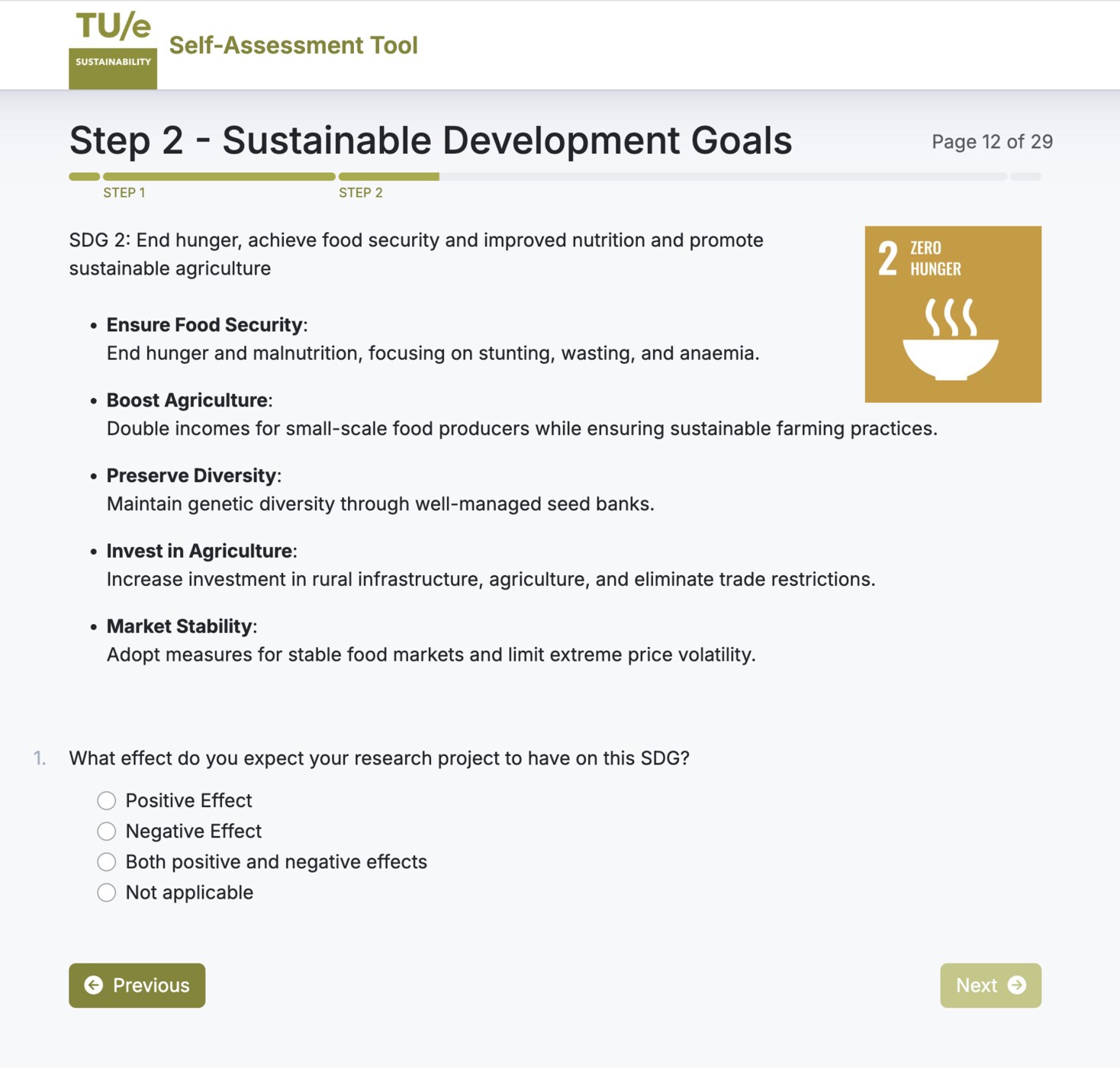
The survey itself is a Vue 3 application, with vue-router handling navigation between the introduction, the multi-step questionnaire, and the result and report views. A small FastAPI backend serves the frontend and receives the anonymous submissions, storing them in a SQLite database, more than sufficient for the expected volume.
The report
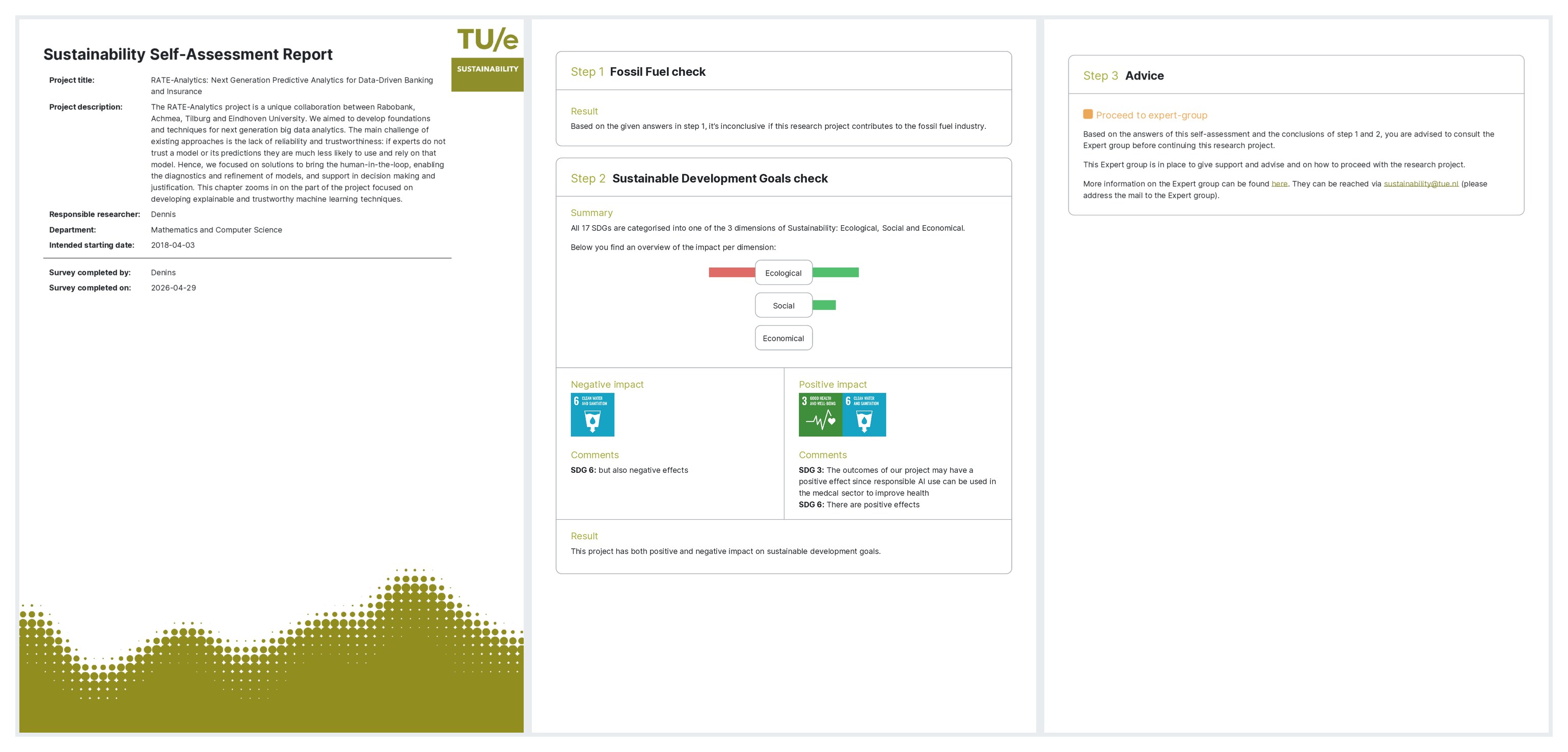
After completing the survey, the tool generates a downloadable PDF report with the project’s status against each of the SDGs, together with recommendations on how to proceed. The report can be added to the project file and shared with the relevant dean and program director, who carry final responsibility for the project.
Deployment
The tool runs on a virtual machine provided by the university, behind an nginx reverse proxy, with the FastAPI service managed by systemd. Unattended upgrades keep the server patched with minimal maintenance. The tool was officially adopted by TU/e in November 2024 and is deployed university-wide.